
Icelandic biology as inspiration for human health - insights from a sailing adventure

Ocean and its diverse inhabitants are an untapped treasure trove for both human health and sustainability. In my day-to-day life, I work on improving the human immune system, but creatures being my passion, I was looking for a way to get closer to the ocean that was not a typical tourist attraction. In doing so, I got a chance to join Hope Expedition 2026, hosted by Ocean Missions. In this photo-heavy writing piece I focus on the various creatures I encountered, and how their biology can be used to treat, enhance, or make humans better. I also share some other reflections on remembering extinct species, monitoring whale speak, and ocean clean-ups.

Note: All images were taken by me (or other members of expedition) and no AI was involved in image generation or processing.
I. Inspirations from Icelandic animals for human health
The Arctic selects for resilience. People attempted to introduce other species to Iceland but most did not make it. In the images to follow, I pose some ideas on how inspiration taken from Arctic animal biology can help humans. Some of the birds mentioned do not stay in Iceland for the whole year, but the summer is still relatively cold and makes them good candidates for looking at cold-adapted mechanisms.
a. Whales:

Whales' lungs fully collapse on every dive and re-inflate on every ascent. It’s a cycle that would injure most of us air-breathers, but a specialized pulmonary surfactant lets whales’ lungs snap back open without damage (Ref: https://pmc.ncbi.nlm.nih.gov/articles/PMC10993460/).
Rorqual whales face a similar extreme-stretch problem in their mouths: to engulf a volume of water bigger than their own body, the nerves in their jaw have to stretch and recoil like bungee cords (Vogl et al. 2015, https://doi.org/10.1016/j.cub.2015.03.007). A collagen sheath acts as a check ligament to stop overstretching, while elastin fibers snap the nerve back to its resting length once the lunge is done. Imagine this as inspiration for injury prevention as humans age.

b. Birds:
Godwits were found all around the coast poking their bills into shallow waters.

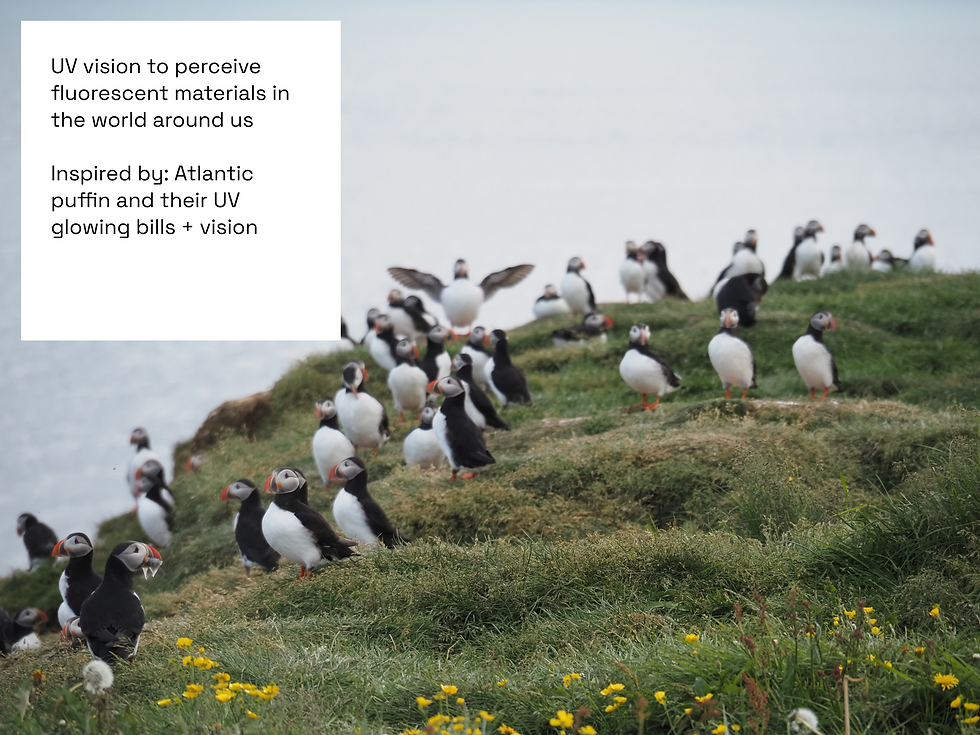
Puffins are cute and clumsy. When you see them fly they look like they’re trying way too hard. Because they are - flapping their little wings between 400-600 times per minute. They are also not the best divers - as they basically “fly” underwater. Whereas penguins chose to give up flight to specialize in diving, puffins actually became a jack of all trades and master of none. It is an adaptation of its own - that manifests as clumsiness in our eyes, but actually works out well for puffins to be able to function in air and in water. What if we could sacrifice specialization in a certain biological function to become capable across different environmental challenges?
In some ways, I find puffins kind of inspiring. When other sea birds ended up specializing, puffins’ biology chose to hedge their bets.
Here are some precise ideas on how puffin biology can inspire human health engineering.
To thrive on the salty ocean, birds need to be able to extract resources from it. Puffins actually have salt glands that allow them to drink oceanic water and filter out the concentrated salt (Ref: https://cdnsciencepub.com/doi/abs/10.1139/z70-081).

There were a lot of ducklings at sea when we visited. It's incredible how they kept diving for food at these cold temperatures (first-hand experience after I went swimming in the ocean). What I learned is that they have an ability to regulate their temperature without specifically using fat. They upregulate a protein called Avian Uncoupling Protein (av-UCP), which is located in skeletal muscles and generates heat by dissipating the proton gradient across the inner mitochondrial membrane (Ref: https://pubmed.ncbi.nlm.nih.gov/20581277/).

c. Sheep:
A shout out to all the sheep that roam Icelandic hills.

II. Whale Speak:
The idea of talking to aliens has always fascinated me. Would we be able to communicate with someone or something that experiences a world so differently from us, even if both sides knew the vocabulary? Can we exchange ideas? Can we make trades?
Whales are such an intelligent species. Some far outpace human life spans. They have access to deep oceans that we have never mapped out. Yet attempts to understand their language or speak to them have been sparse.
One of the things we did on the trip was to dip a hydrophone into the ocean as we sailed. If we saw either dolphins or whales, we would stop the boat and submerge a hydrophone below. Unfortunately, in order to get a recording of a whale (or even a dolphin) you would have to either be lucky or very patient. However, I enjoyed the patience it took, and stopping in different locations to listen. I think that excitement stemmed from listening to something we are not easily tapped into.

A sound you can’t turn off: Ocean noise pollution is not something I ever thought about. When you hear it - it makes a lot of sense. As humans, we have so many tools to escape noise pollution, whereas whales do not. Imagine hearing banging and creaking sounds constantly, unable to talk to your loved ones or let others know of food or danger. Our “connectedness” is breeding disconnectedness in the whale world. This is something to keep in mind as we industrialize and become more connected. Are there other ways to do things that don’t harm life on this planet?
III. Remembering the Extinct
I saw a silhouette of a penguin-like bird in a distant fog, standing on a cliff, with its back to the ocean. Nearby there was an information tablet mentioning that the statue is a Great Auk. These birds were driven to extinction by human hunting, after a volcanic eruption destroyed their last protected refuge and forced them onto an island humans could reach. The experience of finding this silhouette on a volcanic beach was a pleasant surprise. It made me reflect on how we present information in museums. Walking through a museum, from exhibit to exhibit, can feel like being at an information bazaar. It's hard to connect deeply with any one thing. This bird being a surprise find, and the information that came along with it, made me wish we had more of these wonders around the world.

IV. An oceanic band-aid
We did two beach clean-ups as part of the ocean adventure. One near Hrísey and another near Húsavík. I admit that I was skeptical about the effort, as I felt like it wasn’t solving the bigger problem. In doing some research, I also learned that a large chunk of pollution waste is concentrated at the bottom of the ocean. So even though we often think about the large garbage patches at the surface, those make up an estimated 30% (Source: https://ubiqueags.org/map-of-the-week-microplastics-across-ocean-water-column/). I hushed the skeptic inside, and focused on what kind of trash washed up on the pristine beaches of Iceland.

I did learn that the OSPAR surveys are useful in providing data that could change policy. Specifically, if a certain plastic is measured at a high proportion, it can serve as a longitudinal metric to see if there is improvement in that type of plastic pollution.
What I noticed most was fishing nets and fishing industry debris, not consumer plastics as I would have expected. And this was also validated by prior clean-up efforts at sea (https://undecided.tech/how-ocean-plastic-isnt-the-problem/).
In addition to doing beach clean-ups, I thought it would have been good to get people around the table and brainstorm more long-term solutions. In crossing the ocean between destinations, I did get a chance to think about it a bit though.
I am by no means an expert in this, but I will share my brain farts here.
🦠 🪀 Plastic-degradable organisms:
Imagine sprinkling the ocean with organisms that can degrade plastics. There has been some research on an enzyme produced by Ideonella sakaiensis called PETase (Palm et al. 2019).
Pestalotiopsis microspora is a fungus that has been discovered to degrade plastic even in low-oxygen environments. The low-oxygen component is important because it means these strains can be deployed in low-oxygen environments in which other bacteria cannot.
Archaeons also have potential, as some have been identified at hydrothermal sites with PETase enzymes (Acosta et al. 2025). Given that a good proportion of plastics has been detected deeper in the ocean, these could be stationed there.
Some open questions in seeding the ocean with such plastic-recycling organisms:
What volume, and where, could such plastic-degrading organisms be deployed?
How do you measure success in their degrading the plastics? Can they do it fast enough, or do they need to be engineered to do so?
Are there negative side effects in introducing these plastic-degrading organisms to local ecosystems?
⛵ Community ship efforts:
If plastic mounds could be identified, boats at sea could be provided with collection containers to pick up floating trash (assuming it is safe).
Similar efforts are already under way. Ocean Voyages Institute works with volunteer sailors to tag ghost nets with GPS trackers as they cross the Pacific; a dedicated sailing cargo ship (S/V Kwai) later navigates to the clusters and hauls them out — 103 tons recovered in a single 48-day expedition. https://www.oceanvoyagesinstitute.org/ocean-voyages-institute-sets-record-with-largest-open-ocean-clean-up-in-history/
Given so much of the trash being found is from the fishing industry, nets made out of safely degrading materials could go a long way as well. Researchers in Korea developed a biodegradable gillnet blended from polybutylene succinate (PBS) and polybutylene adipate-co-terephthalate (PBAT), and found it began breaking down in seawater within about 24 months while still performing comparably to conventional nylon nets in actual fishing trials (Kim et al. 2016, https://zslpublications.onlinelibrary.wiley.com/doi/abs/10.1111/acv.12256).
Conclusion:
When we disconnect to take a break from daily life, it often leans towards something that rejuvenates, but less so towards our connection with something that is beyond us. There is something therapeutic about immersing yourself with elements that have lived before you and will likely outlive you - ocean, landscapes, animals.
I wanted to give a shout-out to the efforts that fellow travelers have undertaken to look after our oceans.
If you are working at intersection of animal biology and human health, feel free to connect. I hope to do more of these adventures to figure out how nature can inspire human health advancements.
I wanted to give a shout out to efforts that fellow travelers that have undertaken to look after our oceans.
Happy Whale - https://happywhale.com/home
Citizen science effort to map whales and their travels
Animal Fund - https://theanimalfund.net/en/projects/
Hands on projects to connect youth with the ocean
Ocean Missions -


Comments